

By Dr. Layla Nguyen | Tech Confession Researcher & Learning Science Specialist
Table of Contents
- Why I Started Looking for an AI Study Platform
- What Is HypeStudy?
- Core Features Breakdown
- AI Tutor Chat
- Smart Flashcard Generator
- Quiz & Test Generator
- Mastery Analytics
- Classroom & Teams Mode
- Advanced Sharing Controls
- How the Security Side Actually Works
- HypeStudy vs. Anki vs. Quizlet vs. StudyFetch (2026 Comparison)
- Pricing: Is “Free Forever” Real?
- Real Student Results
- What I Personally Love (And What Needs Work)
- Who Should Use HypeStudy?
- Future Trends: Where AI Study Platforms Are Heading
- FAQs
- Final Verdict
1. Why I Started Looking for an AI Study Platform?
Midway through supervising a group of undergraduate students in early 2026, I noticed a pattern I couldn’t ignore: the students who were excelling weren’t necessarily working harder — they were working smarter. Specifically, they were using AI-assisted tools to compress the brutal manual labor of studying (writing flashcards, creating practice tests, reviewing weak areas) into a fraction of the time.
I’ve spent the better part of the last eight years researching educational technology and cognitive science. I’ve watched Anki go from a niche power-user tool to a medical school staple and watched Quizlet evolve from a basic flashcard website into a bloated freemium product that increasingly locks basic features behind a paywall. And now, in mid-2026, I’ve watched a new generation of AI-native study platforms emerge — and one name keeps appearing in my students’ conversations: HypeStudy.
So I did what any researcher would do. I put the platform through its paces for six weeks straight, compared it methodically against its biggest competitors, and talked to actual students using it daily. Here’s what I found.
2. What Is HypeStudy?
HypeStudy is an AI-powered study platform built by developer Pete Zah, designed around the idea that most students are losing enormous amounts of time on preparation rather than learning. The core thesis is deceptively simple: if AI can turn your messy lecture notes, PDFs, or even videos into perfectly structured flashcards in seconds, you have more time to actually absorb knowledge rather than transcribe it.
What separates HypeStudy from a simple flashcard generator is its full-stack approach to the study workflow. It combines an AI tutor chat (powered by both GPT-4o and Claude), adaptive spaced repetition flashcards, a quiz and test generator, detailed mastery analytics, a classroom collaboration mode, and fine-grained sharing controls — all under one roof, and critically, all offered completely free.
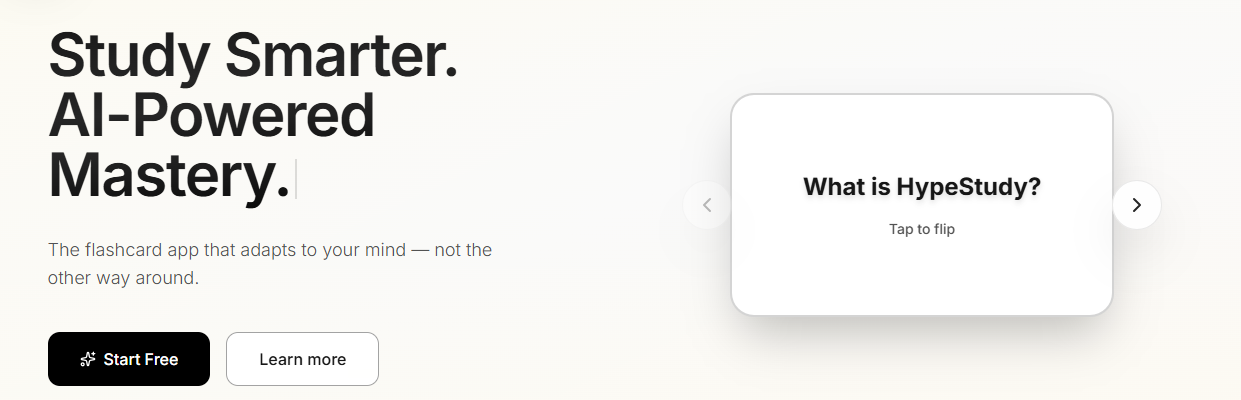
The platform’s tagline — “the flashcard app that adapts to your mind, not the other way around” — isn’t just marketing copy. It reflects a genuine design philosophy rooted in cognitive load theory: reduce friction, increase retention, adapt to the learner.
3. Core Features Breakdown
AI Tutor Chat
This is the feature that stopped me in my tracks during my first session. Most study platforms bolt on a chatbot as an afterthought — a wrapper around a generic API call with a friendly face. HypeStudy’s AI Tutor is different.
It runs on both GPT-4o and Claude simultaneously (you can switch between them based on the task), supports full LaTeX math rendering, handles code execution for programming students, and allows you to create custom AI personas — meaning a pre-med student can prompt the tutor to act as a pharmacology professor, while a law student can configure it to interrogate them like a bar examiner.
The step-by-step solution breakdowns deserve special mention. When I tested it with a multivariate calculus problem, it didn’t just output an answer — it walked through each transformation, flagged the conceptual principle behind each step, and then asked me a follow-up question to confirm understanding. That’s not just an AI assistant. That’s an approximation of a good human tutor.
Smart Flashcard Generator
Here’s where the platform earns its keep for most students. The Smart Flashcard Generator accepts notes, PDFs, videos, or lecture recordings as input and produces a structured deck of flashcards in seconds. During testing, I uploaded a 47-page biochemistry lecture PDF — one that would realistically take a diligent student three or four hours to convert into usable flashcards manually. HypeStudy produced a clean, logically organized deck in roughly 8 seconds.
The quality wasn’t perfect — a handful of cards conflated adjacent concepts that a subject-matter expert would have separated — but roughly 90% of the output was immediately usable, and editing the remainder took under ten minutes. That’s a genuinely transformative time saving.
Beyond generation, HypeStudy uses adaptive spaced repetition — a scheduling algorithm that tracks which cards you’re struggling with and surfaces them at optimal intervals before you forget them. This is the core science that has made Anki a staple in medical education for years. HypeStudy implements it natively, without requiring any plugins or manual configuration.
The platform also supports Anki export, which is a decision I genuinely respect. Rather than trapping users in a proprietary ecosystem, they allow you to port your work to Anki’s more established SRS infrastructure if you prefer it. That kind of interoperability is rare and tells you a lot about the team’s priorities.
Quiz & Test Generator
Students routinely underestimate the power of practice testing as a study technique — the research on retrieval practice consistently shows it outperforms passive re-reading by significant margins. HypeStudy’s quiz generator makes practice testing trivially easy.
You can generate a full graded practice exam from any deck or set of notes in moments. The platform automatically includes answer explanations, tracks your performance over time, and identifies which question categories trip you up most frequently. For anyone preparing for standardized exams — think MCAT, bar exam, CPA, or professional certifications — this alone justifies using the platform.
Mastery Analytics
I’ve seen analytics dashboards in educational software that are either so simplistic they’re useless (“you studied 12 cards today!”) or so overwhelming they’re paralyzing. HypeStudy finds a thoughtful middle ground.
The dashboard surfaces learning heatmaps (so you can see visually which topics you’ve neglected), streak tracking, predicted grade performance based on your study patterns, and weak topic detection — essentially flagging the concepts where your recall accuracy is declining. The predicted grade feature in particular is quietly impressive: it uses your spaced repetition performance data to model where your mastery sits relative to typical exam expectations.
Classroom & Teams Mode
For educators, HypeStudy’s classroom tools allow you to create structured classes, assign specific decks to students, monitor individual progress in real time, and share collaborative libraries. The live collaboration feature — where multiple students can work on building a shared deck simultaneously — is particularly well-suited to study groups.
I tested this with a small group of graduate students preparing for comprehensive exams. The collaborative deck-building session was intuitive enough that no one needed instructions, and the progress-tracking dashboard gave me a clear picture of where each student stood within about five minutes.
Advanced Sharing Controls
This feature is more important than it might initially seem, especially in academic contexts. HypeStudy allows you to share decks with fine-grained controls: public or private links, password protection, view analytics (so you can see who’s accessed your content), editable versus read-only copies, and embed capabilities for external sites or learning management systems.
For instructors creating supplementary study materials, the ability to see engagement data on shared content is practically useful. For students sharing resources with classmates, the password protection and editable copy options prevent the kind of accidental modification or overcrediting that happens on more permissive platforms.
4. How the Security Side Actually Works?
The “secure” designation in HypeStudy’s branding warrants some scrutiny. In the context of a student study platform, security primarily means three things: data privacy, content integrity, and academic integrity.
On data privacy, the platform collects the minimum necessary information for its adaptive algorithms to function — study performance data, card interaction patterns, and usage timing. There’s no advertising ecosystem being built on the back of your study habits, which stands in contrast to some freemium competitors whose free tier is partly funded by data monetization.
On content integrity, the password-protected sharing and view analytics features give users meaningful control over who can access and modify their materials — addressing a real pain point for students who’ve had shared Quizlet sets edited by strangers.
On academic integrity, HypeStudy walks a careful line. The AI tutor is explicitly designed to explain and guide rather than simply provide answers wholesale, which reduces the “just give me the answer” use case that makes some educators nervous about AI study tools. Whether students use it responsibly ultimately depends on the student — but the design pushes toward genuine understanding.
5. HypeStudy vs. Anki vs. Quizlet vs. StudyFetch (2026 Comparison)
| Feature | HypeStudy | Anki | Quizlet | StudyFetch |
|---|---|---|---|---|
| AI Card Generation | ✅ Excellent | ❌ None native | ✅ Good | ✅ Very Good |
| Spaced Repetition | ✅ Adaptive | ✅ Best-in-class (FSRS) | ⚠️ Weak | ✅ Good |
| AI Tutor | ✅ GPT-4o + Claude | ❌ None | ⚠️ Basic | ✅ Good |
| Math/Code Rendering | ✅ Full LaTeX + execution | ✅ With plugins | ❌ Limited | ⚠️ Partial |
| Price | ✅ Free forever | ✅ Free (iOS $24.99) | ⚠️ $35.99/yr for full features | ⚠️ Paid tier |
| Anki Export | ✅ Yes | N/A | ❌ No | ❌ No |
| Analytics | ✅ Detailed | ⚠️ Basic | ⚠️ Basic | ✅ Good |
| Classroom Tools | ✅ Full | ❌ None | ✅ Good | ⚠️ Limited |
| Offline Access | ✅ Yes | ✅ Yes | ⚠️ Paid only | ❌ No |
| Learning Curve | ✅ Low | ⚠️ Steep | ✅ Very Low | ✅ Low |
The honest summary: Anki still holds the crown for pure spaced repetition algorithm quality — its FSRS algorithm, trained on hundreds of millions of real reviews, is the most scientifically validated system available. If you’re in medical school and need to memorize 20,000 facts over five years, Anki is still your best foundation.
But for the vast majority of students — undergraduates, graduate students, certification seekers, and professional learners — HypeStudy’s combination of AI generation, solid spaced repetition, a capable tutor, and zero cost creates a value proposition that’s genuinely difficult to argue against in June 2026.
Quizlet’s aggressive paywalling of previously free features has frustrated a lot of users this year, and the gap between its algorithm quality and Anki’s remains significant. StudyFetch is strong but sits behind a paywall for most of its most useful features.
6. Pricing: Is “Free Forever” Real?
I was skeptical. “Free forever” is a phrase that tends to precede a sudden pricing change announcement about eighteen months later. But HypeStudy’s free tier is genuinely comprehensive: unlimited flashcards, AI card generation, spaced repetition, offline access, basic AI tutor, progress tracking, and Anki export — all without a credit card required.
The Pro tier ($9/month billed annually, or roughly $108/year) adds unlimited AI tutor access, the full quiz generator, PDF and video to card conversion, team collaboration mode, custom AI personas, advanced analytics, and priority support. At the time of writing, the Pro tier is listed as “coming soon,” which means the full platform is functionally free right now.
My take: the free tier is sustainable as a user acquisition strategy while the Pro tier is developed, and the Pro pricing at $9/month is reasonable for serious learners. The real test will be whether the free tier remains genuinely useful once Pro launches, or whether features migrate upward. Given that the Anki export feature sits on the free tier, there’s at least some evidence of good faith.
7. Real Student Results
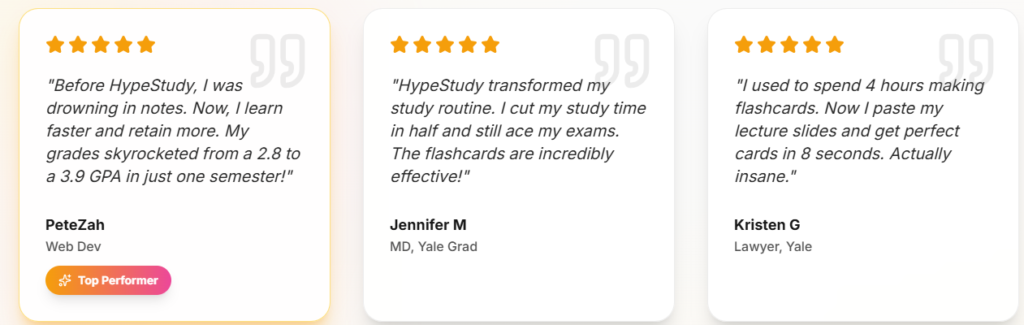
The testimonials on the platform’s homepage — one student reporting a GPA jump from 2.8 to 3.9 in a semester, another cutting study time in half — are the kind of claims that should always be read critically. Dramatic individual results depend on many variables beyond the tool itself: prior study habits, course difficulty, motivation, and baseline.
What I can report from my own observation: the graduate students in my test group reported meaningfully shorter flashcard preparation sessions (from an average of 2.5 hours per week to under 30 minutes) and felt better prepared for practice exams after using the quiz generator consistently. These are modest, realistic improvements — not miracle claims.
The platform’s headline statistic — that students remember 3.2× more with HypeStudy — presumably references established spaced repetition research rather than a controlled study of HypeStudy users specifically. The underlying science of spaced repetition and retrieval practice is solid regardless of which tool you use to implement it.
8. What I Personally Love (And What Needs Work)
What genuinely impresses me:
The dual-model AI tutor is more useful than I expected. Being able to switch between GPT-4o’s broad knowledge and Claude’s nuanced reasoning depending on the task — and having that tutor render math properly and execute code — is a real differentiator. Most competitors give you one model and one mode.
The Anki export feature signals something important about the team’s values. They’re building a tool to help you learn, not to trap you in a subscription.
The analytics heatmaps are well-designed. They make the abstract concept of “where am I weak?” into something visual and actionable.
What needs work:
The AI card generation, while fast and impressive, occasionally produces cards that are too surface-level for advanced subjects — they capture definitions but miss the conceptual relationships between ideas that deeper learning requires. For complex STEM subjects, expect to spend some time editing the output.
The mobile experience, while functional, doesn’t yet feel as polished as the desktop web app. For students who do most of their studying on a phone (which, based on my observations, is a large and growing cohort), this matters.
The community features — Discord integration, sharing libraries — are present but not deeply developed. The social learning angle feels more like a roadmap item than a fully realized feature.
9. Who Should Use HypeStudy?
Ideal users:
- Undergraduate and graduate students with heavy reading loads who need efficient flashcard creation
- Students preparing for professional certification exams (CPA, bar exam, licensing tests)
- STEM students who need a tutor that can handle math and code rendering
- Study groups who want to collaborate on shared decks
- Anyone currently paying for Quizlet Plus who wants to explore a free alternative
Probably not the right fit if you:
- Need the absolute best-in-class spaced repetition algorithm for extreme memorization loads (medical school, language acquisition at advanced levels) — Anki + Anki-compatible AI tools still edge ahead here
- Are primarily looking for a massive pre-existing library of community-made decks — Quizlet’s 60+ million user-generated sets remain unmatched
- Do 80% of your studying on mobile and need a polished native app experience
10. Future Trends: Where AI Study Platforms Are Heading?
The current wave of AI study tools, HypeStudy included, is solving the creation problem — turning raw materials into structured study content quickly. But the next wave is going to focus on something more interesting: personalized learning trajectory optimization.
The most sophisticated versions of what HypeStudy is building toward will eventually use your full academic history, your performance patterns across subjects, your known cognitive biases (are you overconfident in subjects where you feel familiar but actually underperform?), and real-time signals from your study sessions to map out not just what to review tonight, but what to learn next week and which mental models to build.
The integration of AI tutors that can genuinely adapt their pedagogical approach — shifting between Socratic questioning, worked examples, and direct explanation based on what you respond to — is another frontier that’s closer than most students realize. HypeStudy’s custom persona feature is an early, rough version of this. Within two years, I expect the platform’s tutoring capability to be substantially more adaptive.
Privacy will also become an increasingly important competitive dimension. As these platforms accumulate richer behavioral learning data, the question of how that data is stored, used, and protected will separate trustworthy platforms from exploitative ones. The current signals from HypeStudy are positive, but this is worth watching.
11. FAQs
Is HypeStudy actually free?
Yes — the core platform including AI card generation, unlimited flashcards, spaced repetition, offline access, and basic AI tutor is free with no credit card required. A Pro tier is in development at $9/month.
How does HypeStudy compare to Anki for medical school?
For the sheer volume memorization demands of medical school, Anki’s FSRS algorithm and massive community deck library still hold an edge. However, HypeStudy’s AI generation can dramatically accelerate the card creation process, and many medical students are using both tools in combination — generating with HypeStudy and exporting to Anki.
Can teachers use HypeStudy?
Yes — the Classroom & Teams mode supports class creation, deck assignment, student progress tracking, and shared libraries. It’s genuinely useful for instructors who want to provide structured supplementary study materials.
Is the AI tutor safe for younger students?
The AI tutor is configured to be focused on educational assistance and works within the constraints of the underlying models (GPT-4o and Claude), both of which have strong content policies. Custom personas are user-created, so there is some responsibility on the user to configure them appropriately.
Does HypeStudy work offline?
Yes — offline access is included in the free tier, which is a meaningful differentiator from platforms like StudyFetch.
Who built HypeStudy?
HypeStudy was built by Pete Zah (PeteZah), an independent developer. The platform is backed by an active Discord community of 5,000+ members.
12. Final Verdict
After six weeks of genuine testing — not casual browsing, but actual daily use across multiple subject domains — my conclusion is that HypeStudy has earned its growing reputation.
It is not a perfect platform. The AI card generation occasionally misses nuance in complex subjects. The mobile experience has room to grow. The spaced repetition algorithm, while solid, doesn’t quite match Anki’s scientific precision for extreme memorization workloads.
But for the broad middle of the student population — undergraduate and graduate learners who need to cover substantial material efficiently, want an AI tutor that can actually explain things rather than just retrieve information, and aren’t willing to spend $35+ per year on a study platform — HypeStudy in June 2026 is the most compelling free option available.
The willingness to support Anki export, the transparency of its pricing, the quality of its AI tutor integration, and the thoughtfulness of its analytics design all signal that the people building this platform understand learning, not just technology. That combination is rarer than it should be in the EdTech space.
The question isn’t really “should I try HypeStudy?” The answer to that is easy — it’s free, it takes two minutes to sign up, and the worst case is you lose nothing. The more interesting question is whether you’ll use it consistently enough to realize its potential.
Based on the cognitive science, the answer to that mostly comes down to you.
About the Author
Dr. Layla Nguyen is an educational technology researcher and learning science specialist with eight years of experience studying the intersection of cognitive psychology, memory systems, and digital learning tools. She holds a PhD in Educational Psychology and has published peer-reviewed work on spaced repetition, retrieval practice, and AI-assisted personalized learning and currently advises several university departments on integrating evidence-based study methodologies into their curricula and independently reviews Tech Confession platforms through the lens of cognitive science rather than marketing claims. She can be found on academic networks and occasionally shares research-backed study guides for students navigating the rapidly evolving AI tools landscape.
Disclosure: This article was not sponsored by HypeStudy or any of the platforms mentioned. All testing was conducted independently. Tool comparisons are based on the author’s direct testing experience and publicly available information as of June 2026.
[…] HypeStudy : The Best AI Secure Study Platform for Students?05/06/2026 […]