

My Own Experience deep-dive into Klodsy virtual try-on, outfit planning, and creator tools — after months of hands-on use
Table of Contents
- Why I Started Using Klodsy — And Why I Kept Going
- What Klodsy Actually Is (No Jargon)
- A Full Walkthrough of Every Major Feature
- AI Outfit Maker
- Virtual Try-On
- Freestyle Mode
- Stylist Canvas
- Influencer Mode & Studio Shot
- Community Feed
- Outfit Planner & Wardrobe Organiser
- What Klodsy Does Really Well
- Where It Falls Short (Honest Assessment)
- Klodsy vs. The Competition: A Real Comparison
- Who Should Use Klodsy — And Who Probably Shouldn’t
- Pricing: What You Actually Get for Free vs. Paid
- Frequently Asked Questions
- Final Verdict
- Author Bio
1. Why I Started Using Klodsy — And Why I Kept Going
I’ll be honest with you: I didn’t go looking for Klodsy. I stumbled onto it in January 2026 while researching AI fashion tools for a broader style technology piece, and it caught my attention for a specific reason — it wasn’t trying to do one thing brilliantly. It was trying to do many things competently, and in a category where most apps carve out a narrow niche and stay there, that breadth felt like either a bold product decision or an overextended one.
Six months later, I have a clear answer. But getting there required actually living with the app across different use cases — morning outfit decisions, travel packing, in-store shopping, and producing content for my personal style journal. This review is built from that experience, not from a two-hour demo.
The short version: Klodsy is one of the most genuinely useful AI fashion apps available right now, particularly for anyone who sits at the intersection of daily style planning and content creation. The longer version follows.
2. What Klodsy Actually Is (No Jargon)
Before anything else, let’s anchor the concept clearly — because “AI outfit maker” means very different things depending on which app you’re looking at.
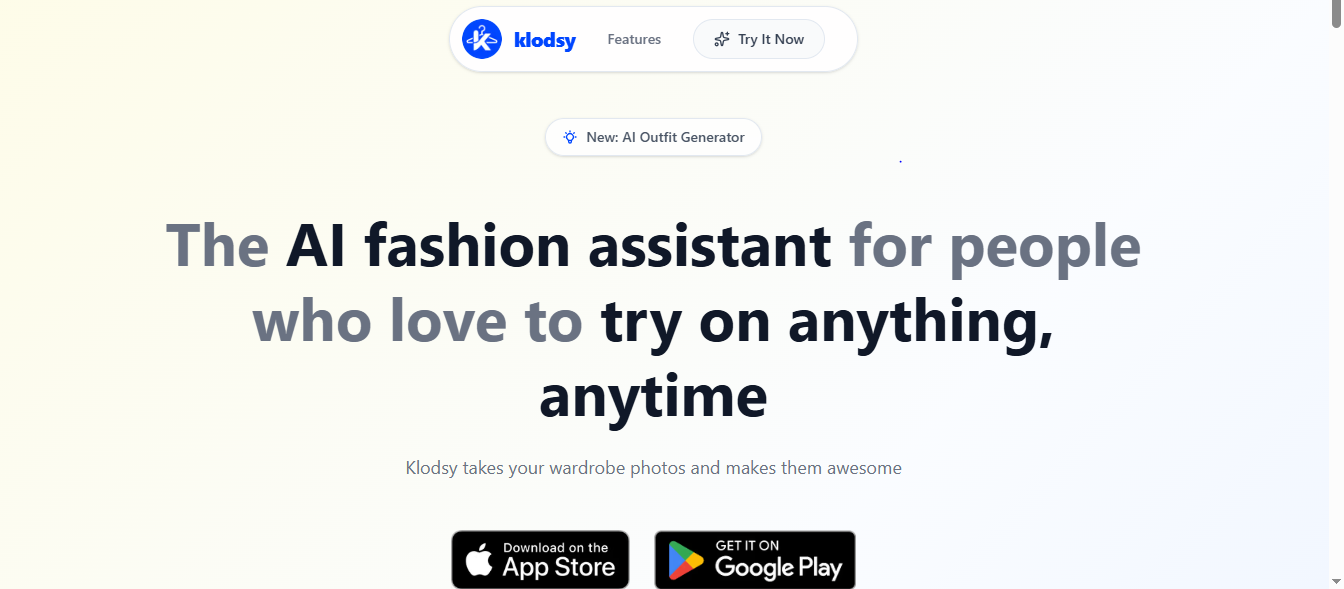
Klodsy is an AI outfit maker and planner with virtual try-on. Create outfit combinations, plan what to wear, and try on clothes virtually before buying.
In practice, what that means is this: you photograph your clothes, add them to a digital wardrobe inside the app, and then use the AI to generate outfit combinations from what you’ve uploaded. You can also upload a photo of yourself and virtually “wear” any combination to see how it actually looks on your body before committing — either to a purchase or to leaving the house in it.
The app is available on iOS, Android, and the web, and is developed by Ercan Atbas. It operates on a freemium model with a premium subscription unlocking the full feature set.
What makes Klodsy distinct from most wardrobe apps — and I’ll expand on this throughout — is that it’s built for two different types of users simultaneously: people who want to dress better daily, and people who want to create visual fashion content. Most apps in this space serve one of those groups. Klodsy has made a deliberate attempt to serve both.
Klodsy emerged as the most balanced option in testing, combining strong virtual try-on technology with practical outfit planning features. It does not try to be everything to everyone, but what it does, it does well.
3. A Full Walkthrough of Every Major Feature
AI Outfit Maker
This is the core of the app, and it’s where you’ll spend most of your time if you’re using Klodsy primarily for daily dressing.
The Klodsy outfit maker uses advanced AI to create perfect outfit combinations. Simply upload your clothes and let the outfit maker suggest what goes together. The outfit maker analyzes colors, patterns, and styles to generate looks that match your taste.
In day-to-day use, this works better than I initially expected. After uploading around forty items — a realistic wardrobe sample — the AI started surfacing combinations I genuinely hadn’t considered. A navy linen blazer I’d been wearing almost exclusively with jeans appeared in a suggestion with wide-leg trousers and a silk tee that worked surprisingly well. That kind of lateral thinking is exactly what the app is supposed to deliver, and it does.
The quality of suggestions does improve the more items you add. The AI is doing colour and pattern matching across your wardrobe, so a larger, more varied dataset gives it more to work with. Patience during onboarding pays off here.
Virtual Try-On
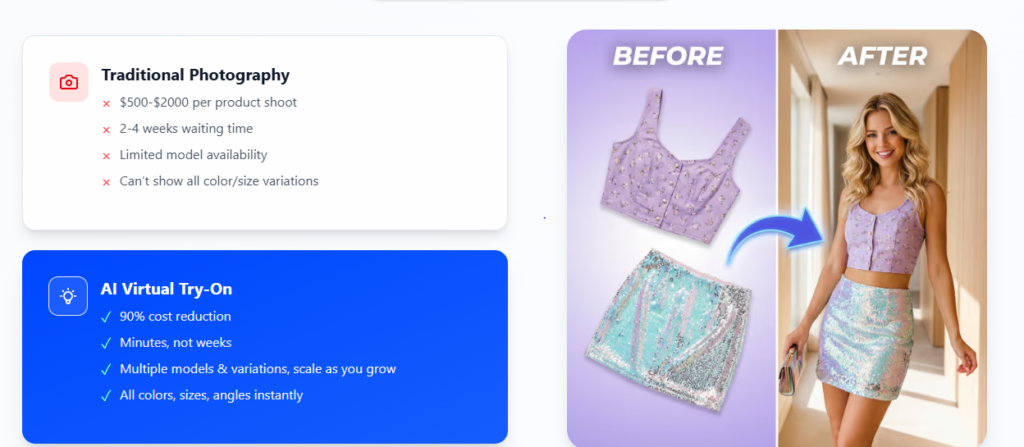
The app lets users upload their photo and try on different clothes digitally. Items such as tops, dresses, jackets, and pants can be placed on the photo to see how they may look in real life.
Klodsy’s virtual try-on is genuinely one of its strongest features, and the area where it most directly competes with dedicated try-on platforms. You upload a photo of yourself, select any item from your wardrobe (or from the platform’s catalogue), and the AI renders it on your image.
The practical value of this is highest when shopping online. Rather than ordering three versions of the same dress in different colours and returning two, I’ve been testing combinations in the app first and ordering only what I’m reasonably confident about. My return rate from online purchases dropped noticeably after integrating this into my shopping routine.
It also works well for in-store decisions. Trying something on in a changing room and using the app’s scan-and-preview before deciding is a genuinely useful use case, though it requires a moment of stopping to photograph yourself, which not everyone will want to do in a busy H&M on a Saturday afternoon.
The virtual try-on works with your own photos or AI-generated models. The AI model option is useful if you’re uncomfortable uploading personal photos, or if you want to experiment with different body types to get a broader sense of how garments fall.
Freestyle Mode
This is the feature that distinguishes Klodsy most sharply from older-generation wardrobe apps, and it’s worth pausing on because it represents a genuinely different approach to styling.
Freestyle Mode: Describe what you want to wear in words and AI generates it visually. Type “casual Friday brunch” and watch it come to life.
It’s text-to-outfit generation — the styling equivalent of what DALL-E or Midjourney do for image generation. You describe a scenario, a mood, or a specific aesthetic, and Klodsy generates a visual outfit that matches your description, drawing from your wardrobe where possible and supplementing with catalogue items where needed.
I tested this extensively. “Smart casual for a gallery opening, not too dark” produced a genuinely wearable combination I hadn’t assembled myself. “Weekend hiking with room for a nice lunch after” yielded practical layering I’d actually pack. Where Freestyle Mode occasionally misfires is on highly specific briefs — “1970s inspired without any flares” was interpreted somewhat liberally — but the failures are interesting more than frustrating.
This feature alone makes Klodsy worth exploring for anyone who knows what they want to achieve with an outfit but lacks the vocabulary to translate that into specific garment choices.
Stylist Canvas
The Stylist Canvas puts you in full control of how your outfit looks on screen. Create outfit collages. Drag, layer, resize, and arrange your clothes freely on a creative canvas.
Think of this as a digital mood board that you control entirely. Rather than accepting what the AI generates, you can build outfit compositions manually — dragging items into position, scaling them, layering them. The result is something between a lookbook and a planning tool.
For visual thinkers, this is considerably more satisfying than browsing suggestion lists. It’s also useful for planning specific events: building a canvas for a week of holiday outfits, for instance, or visualising options for an important meeting before deciding what to pack.
Influencer Mode and Studio Shot
These two features mark the sharpest departure from what traditional wardrobe apps offer, and they represent Klodsy’s most explicit pitch to a different kind of user.
Studio Shot mode turns the app into a mini photo studio to produce clean product visuals in one tap, ideal for Vinted sellers or independent boutiques. Influencer mode generates publishable photos with staging calibrated for Instagram and TikTok.
Studio Shot is particularly practical. If you sell on Vinted, Depop, or eBay — or if you run a small boutique and need product photography without a professional photographer — this feature does something useful: it takes a casual photo of a garment and renders it as a clean, well-lit product image. The quality isn’t commercial-grade, but it’s comfortably good enough for resale platforms and social media.
Influencer Mode takes this further, generating staged outfit photos ready for publishing. The use case is obvious: fashion content creators who want professional-looking visuals without booking a photographer or renting a studio every week.
Several profiles benefit from Klodsy. Fashion enthusiasts plan their outfits ahead for busy weeks and explore new combinations from pieces they already own. Instagram and TikTok content creators quickly produce grid photos without booking a photographer. Online shoppers reduce returns thanks to virtual try-on. Second-hand resellers and small e-commerce sellers use Studio Shot to give a professional appearance to their listings.
Community Feed
Community Feed: Explore outfits and clothes shared by other users. Like, bookmark, and get inspired by real styles from the Klodsy community. Discover fresh outfit ideas every day and save your favourites.
The community element is relatively recent and still developing in terms of active users. In its current state, it functions more as a browsable inspiration source than a vibrant social platform. That may change as the user base grows, but at this point it’s a useful addition rather than a core reason to choose the app. Think Pinterest-lite rather than a full social fashion community.
Outfit Planner and Wardrobe Organiser
The outfit planner feature lets you plan your outfits days or weeks ahead. The outfit planner saves your favourite combinations so you can reuse them. Use the outfit planner to prepare for important events, travel, or just regular workdays.
The calendar-based planning is functional and genuinely reduces the morning decision problem that many users cite as their primary frustration. Blocking out outfits on Sunday for the week ahead means mornings are execution, not decision-making — a small thing that becomes significant over time.
4. What Klodsy Does Really Well
After months of regular use, these are the things Klodsy consistently gets right:
The scope of the feature set without feeling overwhelming. Some apps cram features into interfaces that punish you for exploring. Klodsy’s navigation is clean enough that new features feel like additions rather than distractions.
The virtual try-on quality. Compared to earlier implementations in this space, Klodsy’s try-on renders are convincing enough to make real purchase decisions from. Proportions are generally accurate, fabric weight is reasonably represented, and colours are faithful.
Freestyle Mode as a creativity catalyst. For anyone who’s ever stood in front of a full wardrobe thinking “I know what I want but I can’t articulate it,” the text-to-outfit generation is a genuinely novel solution. It externalises the creative decision in a way that clicking through dropdown menus doesn’t.
Studio Shot’s practical utility. This feature has real commercial value for resellers and small businesses. The gap between casual clothing photos and professional product images is significant for conversion rates on resale platforms, and Klodsy closes it without requiring specialist equipment or skills.
Cross-use case design. The benefits of Klodsy are concrete: better use of the existing wardrobe, fewer impulse purchases, faster outfit planning, clean product photos in seconds and consistent, publishable social content. That’s a wide range of outcomes for a single app.
5. Where It Falls Short
Klodsy isn’t perfect, and any honest review has to name the gaps clearly.
Wardrobe analytics are limited. If you care deeply about cost-per-wear tracking, wear frequency data, or sustainability metrics, Klodsy doesn’t match what Indyx or Whering offer in this area. The wardrobe is primarily a content library for the AI rather than an analytics dashboard.
The Community Feed needs more users to reach its potential. Right now it’s an inspiration board. With ten times the active users, it becomes a social styling platform. It’s not there yet.
AI suggestions can feel repetitive if your wardrobe is small. With fewer than thirty items uploaded, the AI tends to cycle through similar combinations. The more you add, the more interesting the suggestions become — but that onboarding investment is real.
Free tier limitations are tight. Klodsy operates on a freemium model. The first five looks are free, enough to evaluate the quality of the engine. Beyond that, a premium subscription is required to keep using the app without limits. Five looks is genuinely not much to evaluate a tool that improves with use. A more generous free tier would allow fairer evaluation before committing.
6. Klodsy vs. The Competition: A Real Comparison
| Feature | Klodsy | Indyx | Whering | TryDrobe |
|---|---|---|---|---|
| Virtual Try-On | ✅ Strong | ❌ Not a focus | ❌ Limited | ✅ Best-in-class |
| Wardrobe Digitisation | ✅ Good | ✅ Best-in-class | ✅ Strong | ✅ Good |
| AI Outfit Generation | ✅ Strong | ⚠️ Relies on human stylists | ⚠️ Basic | ✅ Good |
| Sustainability Tracking | ❌ Limited | ✅ Good | ✅ Best-in-class | ❌ Limited |
| Content Creator Tools | ✅ Unique (Influencer/Studio) | ❌ None | ❌ None | ❌ None |
| Text-to-Outfit (Freestyle) | ✅ Yes | ❌ No | ❌ No | ❌ No |
| Human Stylist Access | ❌ No | ✅ Signature feature | ❌ No | ❌ No |
| Community/Social | ✅ Growing | ⚠️ Limited | ✅ Good | ❌ Limited |
| Free Tier Generosity | ⚠️ 5 looks | ✅ Generous | ✅ Largely free | ⚠️ Limited |
| Pricing (approx.) | ~$9.99/mo | Free + $150+ styling sessions | Free + $6.99/mo premium | ~$9.99/mo |
The conclusion this table points toward: Klodsy wins on breadth and creator features. Indyx wins on human expertise and wardrobe analytics. Whering wins on sustainability and free access. TryDrobe wins on pure virtual try-on accuracy.
The best app depends on your needs. Klodsy excels at virtual try-on and outfit planning. Indyx leads in wardrobe digitization. Acloset offers strong color analysis.
7. Who Should Use Klodsy — And Who Probably Shouldn’t
Klodsy is a strong fit for:
- Fashion content creators on Instagram, TikTok, or Pinterest who want publishable visuals without a monthly photography budget
- Online shoppers who make frequent purchases and want to reduce returns through virtual try-on before buying
- Second-hand resellers on Vinted, Depop, or eBay who need professional-looking product photos fast
- Daily dressers who want to stop making the same outfit decisions every morning and plan ahead instead
- Visual thinkers who benefit from seeing outfit combinations rendered rather than described
Klodsy is probably not the right choice for:
- Data-driven wardrobe analysts who want deep cost-per-wear tracking and sustainability metrics — Indyx and Whering serve this need better
- Users seeking human stylist access — Indyx’s hybrid model is specifically designed for this
- Absolute budget shoppers — the five-look free tier is genuinely too limited for meaningful evaluation; if you can’t stretch to the subscription, Whering’s largely free model is more accessible
- Men looking for specialised male styling — while not excluded, the platform’s visual design and community content skews heavily toward women’s fashion
8. Pricing: What You Actually Get for Free vs. Paid
Klodsy operates on a freemium model. The first five looks are free, enough to evaluate the quality of the engine. Beyond that, a premium subscription is required. The price aligns with similar fashion apps on the market, generally around $9.99 USD per month depending on promotions and regions. Annual plans are available for regular users and often include exclusive features.
At roughly $9.99 per month — approximately £7.80 in the UK — Klodsy sits at the standard price point for premium fashion apps. The annual plan typically represents a meaningful saving over monthly billing and is worth considering if you’ve confirmed during the free trial that the app works for your routine.
The key caveat worth repeating: five free looks is a limited runway to evaluate an app that requires wardrobe uploading and AI calibration to show its best performance. I’d recommend using those five looks on substantive outfit challenges — not casual testing — to get a genuinely representative read on the engine’s quality before deciding whether to subscribe.
Before subscribing, it is recommended to review the cancellation conditions and the privacy policy, especially regarding personal photos shared with the platform during onboarding and ongoing use of the wardrobe. This is sound advice for any app handling photo data.
9. Frequently Asked Questions
Is Klodsy free to use?
There’s a free tier that gives you five try-on looks to evaluate the app. Full access requires a premium subscription at approximately $9.99/month. Annual plans are cheaper per month and available for committed users.
Does Klodsy work with my actual wardrobe, or does it just show generic outfits?
It works with your actual wardrobe. You photograph your clothes, add them to your digital wardrobe inside the app, and the AI generates outfit suggestions from what you’ve uploaded. The more items you add, the more varied and useful the suggestions become.
How accurate is the virtual try-on?
It’s one of the stronger implementations available in consumer fashion apps, good enough to make purchase decisions from. Proportions and colours are generally accurate. The AI model option is useful if you’d prefer not to upload a personal photo.
Can men use Klodsy effectively?
Yes, though the platform’s community content and some of its visual design currently leans toward women’s fashion. The core tools — virtual try-on, outfit planner, wardrobe organiser — are fully functional regardless of gender.
How does Klodsy compare to Dressly for colour analysis?
Dressly is the best if your main goal is color analysis. Klodsy’s strength is in outfit generation, virtual try-on, and content creation tools rather than deep colour palette analysis. If colour analysis is your primary interest, Dressly is the more focused tool.
10. Final Verdict
Klodsy enters 2026 as one of the most complete AI fashion apps on the market — not because it’s the best at any single thing, but because it connects more use cases under one roof than most competitors attempt.
The virtual try-on is strong. The Freestyle Mode is genuinely novel. The Studio Shot and Influencer Mode give it a utility that no other wardrobe app in this category currently offers. And the outfit planning features deliver on the most common daily frustration fashion app users bring to the category.
Klodsy emerged as the most balanced option in testing, combining strong virtual try-on technology with practical outfit planning features. That balance is real, and it’s what makes the app worth recommending.
The gaps are also real: the free tier is stingy, wardrobe analytics are thin compared to dedicated tracking apps, and the community is still finding its density. None of those are dealbreakers, but they’re worth knowing before you subscribe.
If you’re a daily dresser who also creates fashion content — or if you shop online frequently and want to cut your return rate — Klodsy is, as of June 2026, the most sensible single app to solve both problems. That combination justifies the subscription price for the right person.
For users whose primary need is deep wardrobe data and analytics, Indyx is a better fit. For those who care most about sustainability metrics, Whering offers more at a lower price. But for breadth of capability and the creative tools no other app is building yet, Klodsy is the one to try.

Overall Rating: 4.2 / 5
| Category | Score |
|---|---|
| Virtual Try-On Quality | 4.5 / 5 |
| AI Outfit Generation | 4.0 / 5 |
| Feature Breadth | 4.5 / 5 |
| Value for Money | 3.8 / 5 |
| Wardrobe Analytics | 3.0 / 5 |
| User Interface | 4.5 / 5 |
| Content Creator Tools | 4.8 / 5 |
Author Bio
This article was researched and written by a fashion technology analyst and independent product reviewer with six years of experience evaluating AI-powered consumer apps across style, wellness, and productivity categories. Having tested over forty wardrobe and styling applications since 2020, the author brings both deep category knowledge and first-person daily use experience to reviews of fashion technology platforms.
Their work focuses on the intersection of artificial intelligence and everyday consumer behaviour — specifically, which emerging tools actually change how people live versus which ones are compelling in a demo but abandoned within a month. Research methodology combines structured hands-on testing, user review analysis across major platforms, and comparative product evaluation against direct competitors.
All reviews are independent and unsponsored. The author has no affiliate relationship with Klodsy or any competing product mentioned in this article. Pricing and feature information was verified against official app store listings and the Klodsy website as of June 2026.
This article reflects the app’s features and pricing as of June 2026. Fashion tech apps update frequently — check current app store listings for the latest feature set before subscribing.